Should I continue paying premiums at $6,741 this year?

Or, see how a CEO saved $11,000, a Geologist $5,000, a Doctor $9,590, and an Electrician $3,200...

image of the stack of money

We received an email from Andrew the other day:

"Your research caught my attention because I am paying way above your average most expensive premium! I have an AMP policy which started as an Australian Casualty & Life policy and was put through the blender when AXA took it over mid way. The policy is only for $5,790 per month cover (have stopped escalation) adjusted it to 90 day waiting period a few years ago to reduce premium. Next premium payment is $6,741, due next month. I will be 56. Should I continue with these extortive premiums or do you have a better suggestion?"

Income Protection Mistake

Paying too much is the most common income protection mistake in Australia and Andrew was a perfect example of that.

If you have your income protection policy for 5+ years, you're most likely paying 20-30% more than you should. Insurance companies don't reward the loyalty! And in general Income Protection Insurance prices vary by 30-40% among insurance companies in Australia.

Tax Bracket $45,001 - $135,000 - Example:

Let’s look at Andrew’s example. For a monthly benefit of $5,790, income protection premiums for a non-smoker range from:
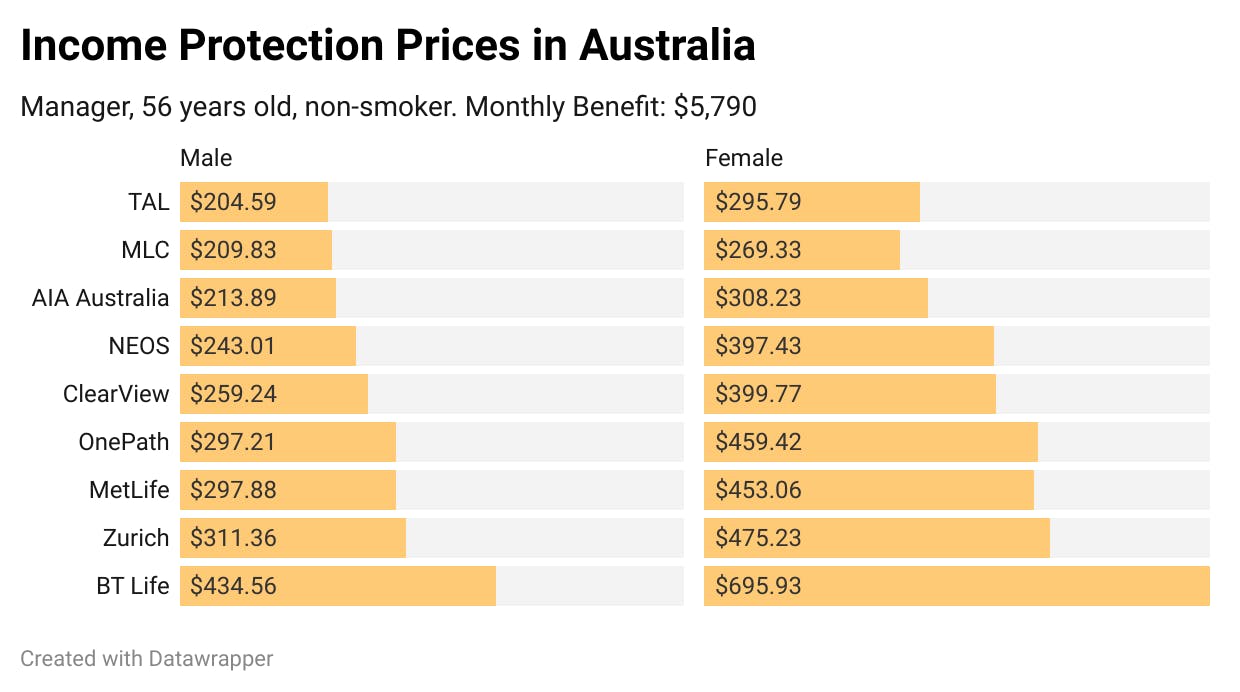
  • Cheapest - $204.59/monthly;
  • Most expensive - $434.56/monthly.
chart of income protection prices in australia

That's a whopping 112% difference or potentially $2759.64 per year wasted! But even the most expensive option is still cheaper than what Andrew was paying.

And just like Andrew, many professionals are unknowingly overspending thousands on premiums. High earners often stand to lose the most through overpriced cover - but also have the most to gain when policies are structured properly. Here are some real examples.

Recent Savings We Delivered for High Earners:

Richard - 60, Male, CEO

  • Was paying $24,000 annually with AIA
  • Now paying $13,000 with Zurich
  • Annual Savings: $11,000
  • Cover: Life, TPD & Income Protection

Sophie - 55, Female, Geologist

  • Was paying $9,000 annually with AIA
  • Now paying $4,000 with TAL
  • Annual Savings: $5,000
  • Cover: Life, TPD & Income Protection

David - 56, Male, Doctor

  • Was paying $18,990 annually with Asteron
  • Now paying $9,400 with TAL
  • Annual Savings: $9,590
  • Cover: Life, TPD, Trauma & Income Protection

Hannah - 34, Female, Advertising Executive

  • Was paying $3,500 annually with MLC
  • Now paying $2,000 with MetLife
  • Annual Savings: $1,500
  • Cover: Income Protection only

Michael - 46, Male, Manager

  • Was paying $7,000 annually with BT
  • Now paying $4,480 with TAL
  • Annual Savings: $2,520
  • Cover: Life, TPD, Trauma & Income Protection

Lucas - 47, Male, Electrician

  • Was paying $7,000 annually with TAL
  • Now paying $3,800 with MetLife
  • Annual Savings: $3,200
  • Cover: Income Protection only

See how much you should be paying for your Income Protection:

See prices from:

list of insurance companies

Frequently Asked Questions about Income Protection Insurance

While financial planners offer valuable investment advice, they may not be the best choice for insurance needs. Investment and insurance advice require different expertise. Insurance advisers specialize in risk management and protection strategies, leading to more comprehensive and tailored solutions. They're also more likely to stay current with frequent changes in insurance products and regulations. For optimal financial planning, consider working with both a financial planner for investments and a specialized insurance adviser for protection needs.
While saving is important, it may not provide adequate protection. Consider this: If your income protection costs $5,000 annually to cover a $100,000 salary, you'd need to save for 20 years to match one year's salary. Income protection offers immediate coverage, whereas saving takes time to build a substantial fund.
This is a common misconception. According to the Australian Prudential Regulation Authority (APRA), 95.2% of income protection claims were "Finalized Admitted" last year. Of the unfinalised claims 92.2% were withdrawn by the claimant or due to inactivity. Most of the remaining unfinalised claims didn't meet contractual definitions or due to exclusion clause. These statistics show that legitimate claims are generally honored.
Yes, there's a flexible option available. If you're experiencing cash flow issues, you can choose to pay for your income protection premiums from your superannuation fund. This allows you to maintain coverage without straining your current budget.
Income protection provides immediate coverage for a substantial portion of your salary if you're unable to work due to illness or injury. Savings, while valuable, take time to accumulate and could be depleted quickly in a crisis. Income protection offers peace of mind and financial stability from day one of your policy.
If premium costs are a concern, discuss options with a financial advisor. They can help you explore paying through your superannuation, adjusting your level of coverage, waiting and/or benefit period or finding a policy that better fits your budget while still providing essential protection.